[Field Notes]
Mental health news for the week of June 4th, 2026
Last week we covered the new Lancet/IHME global mental disorder burden study, the Suicide Crisis Syndrome framework, and the semaglutide-and-motivation RCT. This week the two big American Psychiatric Association journals dropped their June issues — both leading on suicidality treatment — and the American Society of Clinical Psychopharmacology meeting in Miami produced fresh data on an LSD-based phase 2b program and on metabolic-psychiatric overlap.
Add-on extended ketamine’s anti-suicidal effect — but not its antidepressant one
Researchers at Stanford published a randomized, double-blind, placebo-controlled trial in the American Journal of Psychiatry testing whether low-dose sublingual buprenorphine — a partial mu-opioid receptor agonist — given after IV ketamine could prolong ketamine’s effect on suicidal ideation in major depressive disorder. The single-site outpatient trial was designed to test a mechanism: prior work has suggested ketamine’s anti-suicidal and antidepressant effects are partly mediated through the brain’s mu-opioid receptor pathways, not only through its more famous NMDA-receptor action. (American Journal of Psychiatry)
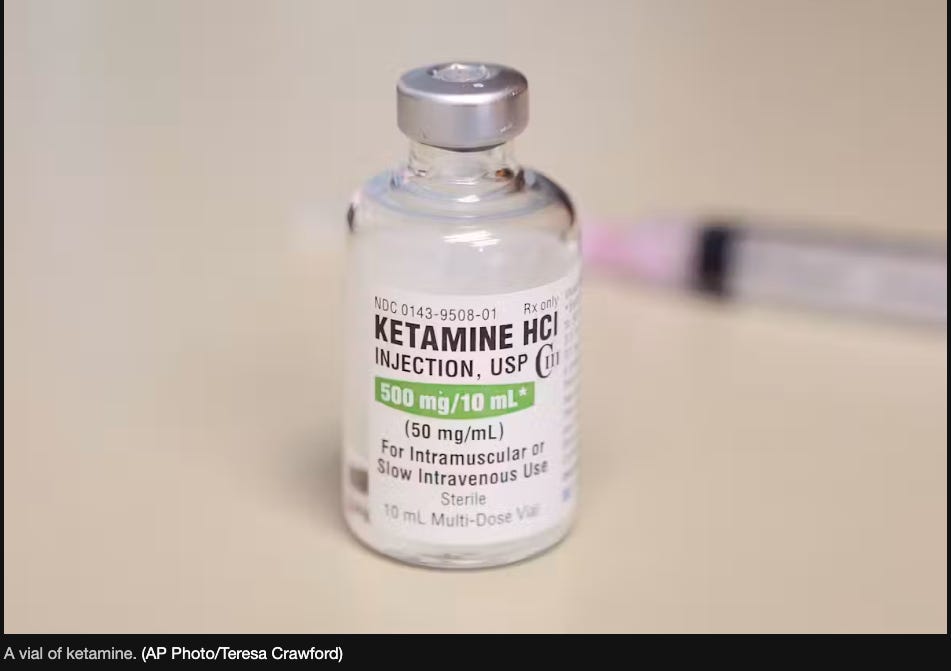
“Ketamine rapidly reduces suicidal ideation in major depressive disorder (MDD), but its effects are transient.”
The headline finding: buprenorphine extended ketamine’s reduction in suicidal ideation, but did not extend its antidepressant effect. The authors and outside commentators have called the dissociation between the two effects the most interesting result — it suggests suicidality and depression may have partly separable underlying neurobiology, and that targeting the opioid system specifically may be the right lever for suicidal crisis even when the broader depression doesn’t fully lift. (Healio summary / Neuroscience News)
A pharmaceutical LSD posts updated safety data
At the 2026 American Society of Clinical Psychopharmacology meeting in Miami (May 26–29), Definium Therapeutics presented detailed adverse-event data from its phase 1 and phase 2b studies of DT-120, a pharmaceutically optimized formulation of lysergic acid diethylamide (formerly known as MM120).
The compound holds an FDA Breakthrough Therapy Designation for GAD, granted in 2024. Four phase 3 trials are now active — two in GAD, two in MDD — with the first MDD topline readout (the Emerge trial) expected by the end of the current quarter and two GAD readouts (Voyage, Panorama) expected in Q3. The company has also flagged a phase 3 PTSD program (Haven) projected to begin in 2027. The CMO presenting the data noted that no new pharmacologic agent has been approved for GAD in more than 19 years. (Definium Therapeutics SEC filing)
One year of war, measured: Israeli civilians, age, gender, ethnicity, and betrayal
A four-wave longitudinal study published in the June issue of Psychiatric Services followed 1,052 Israeli civilians ages 18–40 living in high-conflict areas over the year following the October 2023 events. Assessments at baseline (February 2024) and at 1-, 3-, and 12-month follow-ups measured anxiety, depression, PTSD, and a separately validated construct the authors call institutional betrayal — the perception of being abandoned or let down by trusted leaders and institutions. (Psychiatric Services)

Younger adults, women, and ethnic-minority participants reported significantly higher anxiety, depression, PTSD, and betrayal scores than their counterparts across the study period. The findings build on a broader line of research — including a 2025 longitudinal study from the same group — connecting betrayal-related moral injury (feeling abandoned by trusted institutions) to mood, anxiety, and PTSD symptoms in civilians, not just combatants. (Related Psychol Trauma paper, 2025)
Suicide rates among veterans with serious mental illness, broken down by sex and age
Also in the June Psychiatric Services issue: an analysis of suicide rates among U.S. veterans with serious mental illness (SMI), broken out across sex and age groups. The study is a VA Office of Mental Health collaboration involving the Serious Mental Illness Treatment Resource and Evaluation Center and several VA medical centers. (Psychiatric Services)
Serious mental illness — generally including schizophrenia, schizoaffective disorder, bipolar disorder, and severe major depression — has long been associated with elevated suicide risk, as has veteran status. This analysis is part of a continuing VA effort to characterize where those two elevated-risk profiles overlap and to identify which sex-and-age combinations carry the highest risk, with the goal of more targeted intervention. (APA June 2026 press release)
The reading pile
Trauma and Recovery: The Aftermath of Violence — From Domestic Abuse to Political Terror by Judith Lewis Herman. The current edition (most recent reissue with a new epilogue from the author) is back in active circulation in trauma reading lists this year, and the betrayal-and-moral-injury research above sits squarely in the framework Herman first laid out in 1992. Foundational rather than new.


That’s the week. Next Thursday I’ll be back with another round.
If something here hit you sideways or you want me to dig deeper on any of these, leave a comment or hit reply — I read everything.
‘Til next week, take good care of yourself.